
On Tuesday, voters handed control of both the U.S. House and Senate to Democrats. In a midterm election marked by high consumer prices, redistricting and scandal-plagued candidates, voters pushed back on President Trump’s governance.
Now, the president will need bipartisan support to move any legislative priorities, or face two years of roadblocks in Congress. The momentum for Democrats also carried into state elections, as they flipped several governorships and chambers controlled by Republicans for decades.
What it Means for Convenience Services
At the federal level NAMA will be closely watching to engage with legislative action on price setting, food and nutrition, and trade policy which Democrats have signaled to be top priorities. NAMA will also closely monitor states with new Democratic trifectas, including Wisconsin and Pennsylvania, where lawmakers may look to pass more partisan legislation that could impact the industry.
Democrats Seize Control of Congress
Seat flips and retirements will bring new faces to both sides of the aisle, especially within the Democrat party. Tuesday’s election delivered an overwhelming victory for Democrats in both the House and Senate. Low presidential approval ratings, high grocery and gas prices and an unpopular global conflict created what many in Washington are calling a “blue tsunami.”
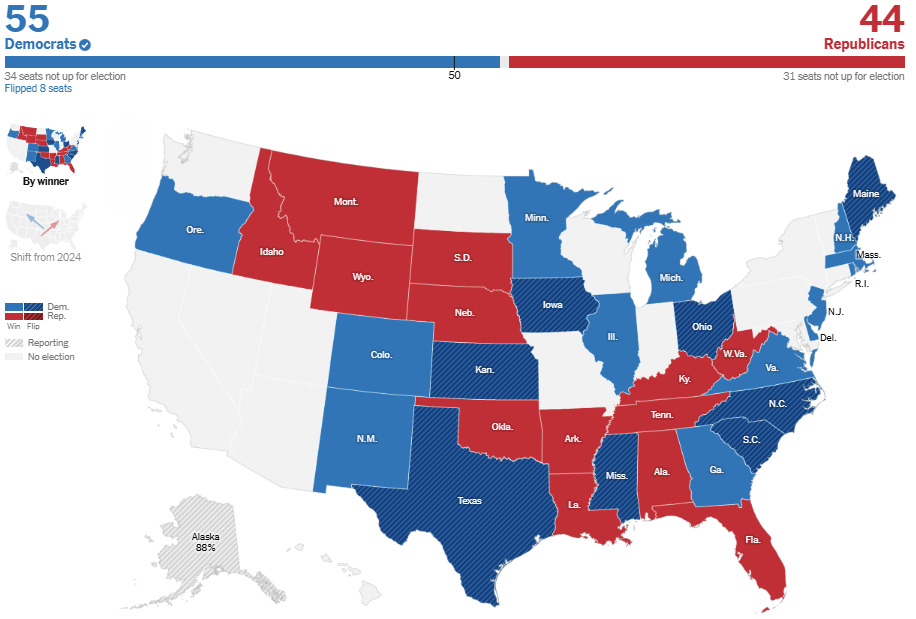
Flipping the Senate: Seven Senate seats flipped for Democrats, several in historically Republican strongholds. James Talarico (Texas), Adam Hamilton (Kansas) and Annie Andrews (South Carolina) all represent significant flips in states that rarely elect Democrats statewide. North Carolina, usually a swing state, overwhelmingly elected current governor Roy Cooper to the Senate. The Midwest swung for Democrats Sherrod Brown in Ohio, Josh Turek in Iowa and Abdul El-Sayed, a closely watched progressive, in Michigan. Even strong incumbent Maine Senator Susan Collins was defeated by Democratic challenger Troy Jackson, and Mississippi elected Democrat Scott Colom over incumbent Republican Senator Cindy Hyde-Smith.
Democrats now hold 55 Senate seats, while Republicans have 44. But the tally isn’t final. At the time of publication, the Alaska Senate race remains uncalled and competitive. Seat flips and retirements will bring new faces to both sides of the aisle.
While these wins give Democrats a comfortable Senate majority, it does not mean they can shut their Republican counterparts out. Lawmaking in the Senate often requires 60 votes to move bills for a vote or even unanimous consent to fast track some legislation. This means that Democrats in the Senate will either have to work with Republicans or use special maneuvers with limited power to circumvent them.
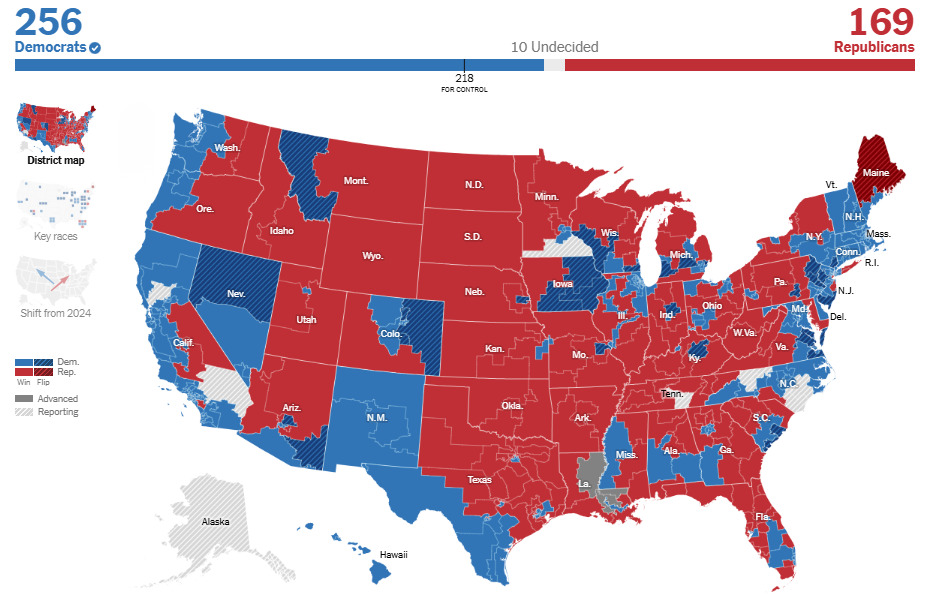
More than a Majority: Election predictions agreed Democrats were favored to control the House of Representatives. But would they have a slim majority or true mandate? As races continue to be called, the number of Democratic seats keeps ticking up. At the time of publication, Democrats have gained a net 44 House seats for a total of 255 far beyond the 218 they needed for a majority. Republicans currently hold 169, and with 11races still uncalled.
House seats flipped across the map, with Democrats making gains in Michigan, Wisconsin, Iowa, Indiana, Kentucky, New Jersey, Virginia, Pennsylvania, Texas, Nevada, Colorado and California. They are expected to continue picking up seats as more results are finalized.
An Agenda Taking Shape: Democrats must now determine how to deliver on their campaign promises. An ambitious agenda may garner significant support within the political party; however, President Trump retains the authority to veto passed legislation. Bipartisan deals may be possible on energy permitting reform, cryptocurrency regulation and farm aid, and Democrats will need to compromise with Trump to secure a signature or with Congressional Republicans to override a veto.
Democrats made affordability a cornerstone of their campaign messaging, and it’s expected that their top priorities in 2027 will reflect this. Early efforts will likely include trying to restore federal cuts to food assistance and healthcare funding. Oversight will be another key component of their agenda, with Democrats likely to seek answers from Trump administration officials and Big Tech CEOs, among others.
Priorities for Convenience Services
Food labeling and pricing are expected to command attention in 2027. Senator Bernie Sanders is anticipated to chair the Senate committee that handles health issues and will likely push for a deal on front-of-pack labeling. NAMA has been working to ensure convenience services are not targeted for additional requirements and has partnered with coalition allies to advocate for a federal labeling standard that would trump the patchwork of state laws and prevent the stigmatization of safe products. Democrats have also signaled plans to investigate the use of personal data in pricing decisions and potentially limit those practices. NAMA will continue to engage in negotiations to protect loyalty programs and operators’ ability to set prices based on market and location.
What NAMA is Watching
The period between the election and the start of the new Congress is anything but down time. In addition to passing the final policy and funding bills for this Congress, levers are moving in Washington to organize power and priorities for 2027.
House and Senate Democrats and Republicans will determine committee membership and leadership. Committee chairs can hold hearings and bring bills for a committee vote, giving them influence over the Congressional agenda. NAMA will build relationships with majority and minority leadership on relevant committees, along with committee members whose votes will be key to the industry’s priorities.
NAMA will also continue to monitor activity within the executive branch and federal agencies. Executive orders and agency rulemakings do not need Congress and will likely be tools that the president uses to advance his agenda.
Governors Go Blue
The blue tsunami reached deep into the states, as Democrats flipped governorships in Georgia, Iowa, Nevada, Ohio and Texas. Nevada Governor-elect Aaron Ford secured a new Democratic trifecta, meaning the party controls both legislative chambers and the governorship. Keisha Lance Bottoms (GA), Rob Sand (IA), Dr. Amy Acton (OH) and Gina Hinojosa (TX) also broke Republican trifectas in their states.
Kansas’ and Alaska’s gubernatorial races remain too close to call, but Democrats lead in both. If their lead in Kansas holds, Democrats will keep all their current governorships. There will be at least 28-30 Democratic governors in 2027, the most since 2010.
A similar pattern prevailed for Democrats in state attorneys general races, flipping seats in Ohio, Georgia, Iowa and Texas. Democrats will hold 27 attorneys general offices in 2027.
Dr. Acton’s win in Ohio may spur action from Republican lawmakers to pass new legislation before 2027. That could include House Bill 762, which fixes the state’s inconsistent sales tax rules for vending and micro markets. NAMA will continue working with Ohio industry leaders to advocate for the bill’s advancement.
Democrats Dominate in State Legislatures
Democrats also made historic gains in state legislatures, controlling a majority of statehouses for the first time since 2010. After Democrats flipped chambers in Arizona, Michigan, Minnesota, Pennsylvania and Wisconsin, new trifectas will take shape in each of these states. Chambers in Georgia, New Hampshire and Texas also flipped in favor of Democrats. Combined with a new Democratic governor in Nevada, Democrats have at least six new state trifectas. Republicans did not flip any state chambers across the country.
Below are the results from the most contested state legislative races:
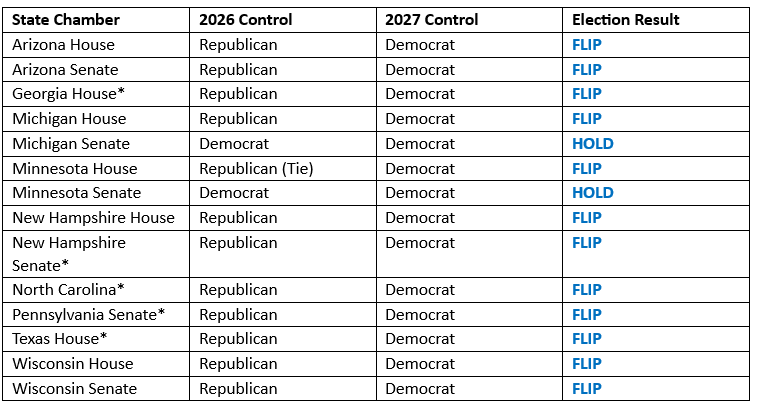
Arizona: Democrats flipped both chambers, securing a trifecta for Governor Katie Hobbs (D) as she enters her second term.
Georgia: Democrats flipped the House for the first time in more than 20 years. Republicans will hold the Senate, but the balance of state power has shifted heavily toward Democrats after Keisha Lance Bottoms’ (D) gubernatorial victory.
Michigan: Democrats flipped the Republican-led House, which held a narrow majority before the election. That flip gives a trifecta as Governor-Elect Jocelyn Benson (D) prepares to enter office.
Minnesota: Democrats won the majority in the House, ending a tiebreaking advantage held by Republicans. Democrats also held the Senate, setting up a trifecta for Governor-Elect Amy Klobuchar (D).
New Hampshire: Although Republican Governor Kelly Ayotte won her re-election, both chambers flipped to Democrats. While the House now has a Democratic supermajority, Democrats fell short of a Senate supermajority by one seat. That means New Hampshire will have a divided government for the next two years.
North Carolina: Republicans were one seat away from a two-thirds supermajority in the North Carolina House before Tuesday. Despite this advantage, Democrats flipped the chamber for the first time since 2010. With a Republican-controlled Senate, Governor Josh Stein (D) will navigate a split legislature in the second half of his first term.
Pennsylvania: Democrats believe they have ended the Republicans’ 32-year stronghold on the Senate majority. By also gaining seats in the House and reelecting Governor Josh Shapiro (D), Pennsylvania will have its first Democratic trifecta since 1994.
Texas: Democrats flipped the House. Combined with Gina Hinojosa’s gubernatorial victory, Republicans’ 24-year trifecta in the country’s second largest state came to an end. Republicans still control the Senate, setting up a split legislature for 2027.
Wisconsin: Democrats saw opportunities to flip both chambers in Wisconsin and were successful. Both flips will give Governor-Elect David Crowley (D) a trifecta.
The Big Picture: There will be 1,696 new state lawmakers in 2027, up 17% compared to the 1,451 new state lawmakers in 2023. The extreme turnover creates opportunities for NAMA, state councils, and industry leaders to build new relationships with lawmakers and educate them on emerging policy priorities.
Ballot Initiatives
Voters decided 164 ballot measures across 40 states in this year’s midterms. Below are some of the issues that most directly impact businesses:
Income Taxes:
California rejected Proposition 40, which would have imposed a one-time state tax of 5% on billionaires’ net worth. Colorado approved measures toestablish a progressive state income tax and end the state’s flat income tax rate of 4.4%. Earners above $500,000 will pay higher state income taxes starting next year.
Iowa approved an amendment requiring a two-thirds vote from both chambers to increase taxes.
North Carolina approved an amendment to lower the state’s maximum income tax from 7% to 3.5%.
Washington rejected a measure to block the state’s upcoming tax on millionaires. A 9.9% tax on all income above $1 million remains set to take effect in 2028.
Property Taxes:
Louisiana rejected an amendment to block local governments from removing real-estate value assessment deadlines.
North Carolina approved an amendment requiring the state to cap the growth of local property tax revenues. Localities will have to lower tax rates if increasing property values push them over the cap.
Oklahoma rejected lower annual growth limits on real property tax rates after new value assessments.
Tennessee approved a ban on all state-wide property taxes.