
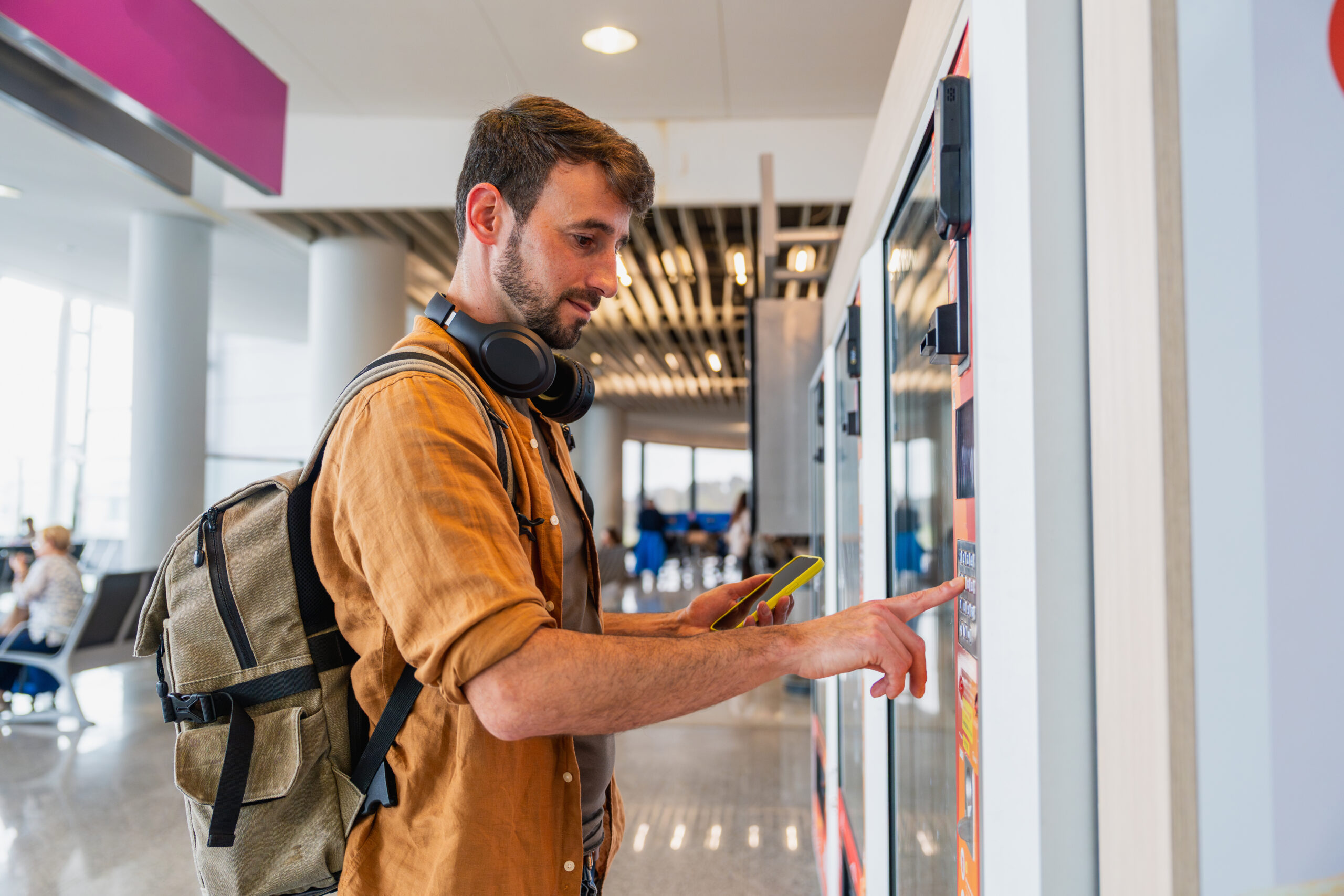
Where Movement Becomes a Marketplace: Inside Today’s Evolving Transit Hubs
Transit hubs are built for movement but they are increasingly no longer places to just pass through. Across the country, terminals and stations are being redesigned to accommodate heavier traffic, multimodal connections, expanded amenities, and changing expectations around food, convenience, and accessibility. Airports are leading the change, but rail stations, commuter nodes, and bus terminals are all moving in the same direction, each at a different speed and with a different operating logic.
For convenience services operators, those shifts matter because transit environments behave differently than almost any other location or account type. Passenger traffic fluctuates around boarding schedules, commuter peaks, delays, weather disruptions, and late-night arrivals, creating concentrated periods of demand followed by quieter intervals. Travelers are also operating with greater time sensitivity and fewer practical alternatives, particularly inside secured airport terminals or large rail stations where leaving the facility may not be feasible.
Those conditions shape both consumer expectations and operational requirements. As those environments evolve, so does the role unattended retail can play inside them.
A Transportation System Operating at Scale
Travel activity across the United States remains historically high across multiple modes of transportation.
From January through May 2026, the Transportation Security Administration screened roughly 2.4 million passengers a day at U.S. airport checkpoints, according to TSA passenger volume data. Meanwhile, the Federal Aviation Administration’s Air Traffic Organization manages roughly 44,000 flights and more than 3 million airline passengers daily through U.S. airspace.
The nation’s largest airports continue to process staggering passenger volumes. Hartsfield-Jackson Atlanta International Airport handled more than 108 million passengers in 2025, maintaining its position as one of the busiest airports in the world.
Yet aviation is only one part of the story.
Amtrak reported an all-time ridership record in fiscal year 2024, with 32.8 million passenger trips nationwide, reflecting continued recovery and growth in intercity rail travel. At the local level, transit agencies across major metropolitan areas continue investing heavily in station modernization, rail expansion, and multimodal transit centers designed to connect commuter rail, buses, micromobility, and pedestrian traffic into single transportation ecosystems.
Federal infrastructure funding is accelerating many of those projects. Through the Infrastructure Investment and Jobs Act, billions of dollars are flowing into airport terminal redevelopment, rail modernization, Bus Rapid Transit systems, and station accessibility upgrades nationwide.
Behind this and other funding, a massive build cycle is underway. More than 160 miles of new rail, bus, and fixed-guideway transit lines opened across the U.S. in 2025, with another 94 miles projected to open by year end. California alone has 119 miles of high-speed rail under active construction in the Central Valley.
The result is a transportation landscape that is not simply recovering from pandemic-era disruption, but evolving into something structurally different than it was even a decade ago.
Why Transit Behaves Differently
Transit hubs compress consumer decision-making into unusually narrow windows, creating a buying environment unlike other account types such as breakrooms.
Unlike workplace accounts — where purchases are often habitual and anchored to routine — transit purchases tend to be reactive. The decision to buy something is often triggered by a gap: a missed meal, a forgotten charger, a child who needs something to do for the next three hours. Those conditions shape both what sells and how it needs to be sold, and influence everything from product mix and replenishment cadence to equipment placement and service model.
Airports and transit authorities are responding to these shifts. Mass Transit Magazine reported in 2025 that transit agencies are increasingly focused on the relationship between station environment and passenger well-being, citing a growing body of research showing that station quality affects commercial engagement and satisfaction simultaneously. The U.S. Department of Transportation (DOT) recently launched a $1 billion initiative to make travel more family‑friendly — funding children’s play areas, nursing rooms, sensory spaces, and redesigned checkpoints, and better access to fresh, whole foods. DOT highlighted companies like Farmer’s Fridge as examples of how airports are rethinking food availability.
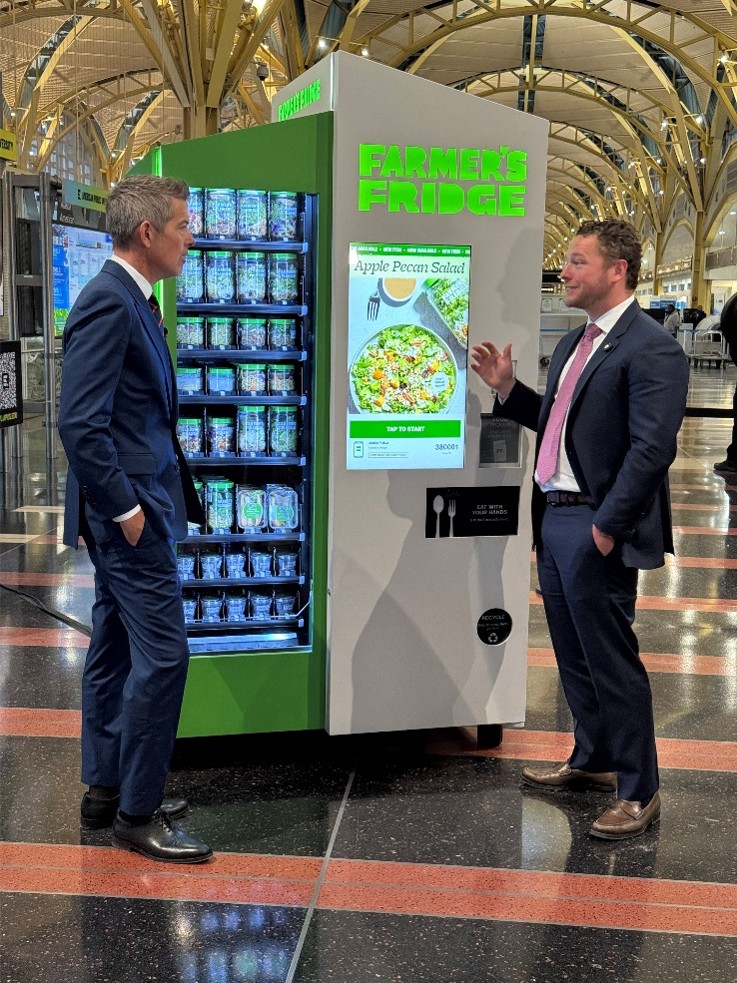
“Farmer’s Fridge operates more than 160 Fridges across the busiest airports in the country, feeding thousands of travelers each day,” said Luke Saunders, Farmer’s Fridge Founder and CEO. “We are focused on making fresh, healthy food as accessible as a candy bar and ensuring nutritious options are affordable, convenient and accessible around the clock.”
That matters because family-friendly design and food access are really part of the same operational story. A terminal that is being rebuilt around longer waits, parents with children, and passengers who need to eat quickly is also a terminal where unattended retail becomes more useful.
At the LAX/Metro Transit Center, VenHub introduced a 24/7 autonomous store that uses robotics and computer vision to keep service available even during late‑night and early‑morning hours. The timing isn’t accidental; Los Angeles is preparing for major events like the 2026 World Cup and 2028 Olympics, when traveler volume and demand for around‑the‑clock amenities will spike.
New York’s subway system offers another example of how unattended retail is filling gaps in traditional transit environments. CC Vending, in partnership with the Metropolitan Transportation Authority and Coca-Cola, has introduced cashless vending machines at several stations, providing drinks, snacks and other convenience items. The company plans to expand the program to additional stations over the next several years, creating another model for bringing everyday essentials into high-traffic transit spaces.
Traffic patterns in transit are also unlike almost any other convenience-services environment. Demand surges around boarding waves, commuter peaks, weather disruptions, and late-night arrivals. Quieter intervals follow. Many transit facilities operate across service windows that begin before 5 a.m. and extend past midnight, periods when traditional foodservice is closed and the unattended format is the only option in the building.
Even within transit, environments vary considerably. Airports typically involve longer dwell times and a captive post-security audience with limited ability to leave the facility. Rail stations often function more like high-velocity commuter environments, with shorter decision windows and demand concentrated around morning and evening travel. Bus Rapid Transit corridors introduce a different pattern again — blending transit ridership with street-level commercial zones, walkability, and mixed-use density. A mobility hub, purpose-built around the transfer between modes, creates yet another profile: a passenger who arrived on one system, is waiting for another, and has an unpredictable amount of time in between.
Those distinctions influence everything from product mix and replenishment cadence to equipment placement and service model.
Infrastructure as Catalyst
For convenience-services operators, infrastructure matters when it changes the commercial math of a location. A new station, terminal, or transfer point does not automatically create a good account. What it can do is change the mix of people, time, and nearby alternatives in ways that make a location behave differently than it did before.
That is the lesson many operators already understand from outside transit. When Nationals Park opened on Washington, D.C.’s riverfront in 2008, the stadium did not just bring baseball to a neglected stretch of the city. It changed the density equation. Suddenly there were more people, more reasons to linger, more adjacent development, and more commercial confidence. Transit projects can do something similar, though often more quietly: they turn a pass-through stop into a place where people wait, transfer, and return every day.
That logic is now playing out at transit stations across the country, at a pace and at a volume that is difficult to track from any single vantage point.
Penn Station in New York makes the same argument at a scale. A planned $7 billion reconstruction would remake the busiest rail station in the Western Hemisphere with wider concourses, more natural light, improved circulation. The daily visitor count, an estimated 600,000, already exceeds nearly every airport. The proposed rebuild matters because it changes not just the passenger experience but the viability of what can operate inside the station. Better circulation, more legible waiting areas, and cleaner commercial footprints all make a difference in environments where a few minutes of dwell can make or break a sale.
A Space Worth Understanding
Transit hubs and travelers’ needs are changing along with the expectations around food, convenience, and service. The infrastructure being built today — from autonomous stores to fresh‑food vending to family‑friendly terminals — is creating a landscape where unattended retail can thrive.
For operators, the question isn’t whether transit is an opportunity. The question is how to think about it: What kinds of products work in low‑dwell environments? What equipment can handle 24/7 uptime? What service model supports twice‑daily restocking? What partnerships matter? What locations are worth pursuing?
The answers will vary by capability and interest. What’s clear from the data is that transit environments are changing quickly, and they’re becoming more relevant to the broader conversation about where people access food and convenience on the go. Understanding how these spaces are evolving simply gives operators another lens as they think about the mix of locations that make sense for their business.
Stay Informed. Stay Ahead.
NAMA members get more than representation—they get resources. This article originally appeared in NAMA’s member-only magazine InTouch.